
This is because it is equipped with an AI intelligent interactive movement. It is not a rigid plush toy; it is endowed with “senses”: its eyes can think, its nose can recognize things, and even the mole on its chin hides a secret. When you touch it, its body will move, and it can feel your temperature! In short, it accompanies you like a real person.

Functions of the AI intelligent interaction movement
The three major functions of the AI intelligent interaction movement, namely “intelligent voice dialogue”, “LCD display (intelligent eyes)”, and “action interaction”, correspond to “auditory communication”, “visual feedback”, and “physical response” respectively. The three functions work together to achieve a three-dimensional interaction of “being able to hear, see, and move”, making hardware products more anthropomorphic and interesting.
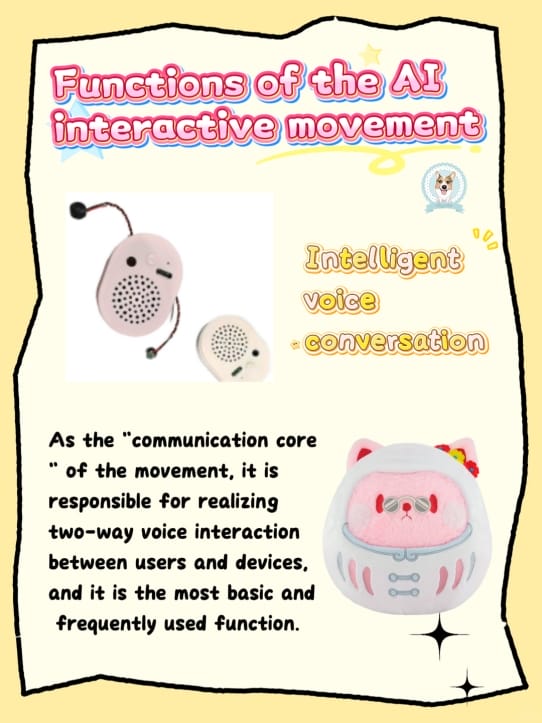
- Intelligent Voice Dialogue (Core Auditory Interaction Function): As the “communication core” of the movement, it is responsible for realizing two-way voice interaction between users and devices, and is the most basic and high-frequency function
(1) Voice Wake-up and Response: Supports custom wake-up words, continuously monitors with low power consumption in standby mode, wake-up response delay ≤ 1 second, effective sound pickup distance is 1-5 meters, and can accurately identify in noisy environments through noise reduction algorithms.
(2) Speech Recognition and Understanding: Can recognize multiple common languages, supports offline recognition (tens to hundreds of fixed commands) and online semantic understanding.
(3) Speech Synthesis and Dialogue: Converts text into natural voice output, provides various timbres such as children’s voice, cartoon voice, and adult voice, and supports adjusting speech rate and intonation; can realize multi-turn continuous dialogue and remember the context.
(4) Content Output and Command Execution: Can play preset content such as children’s songs, stories, and popular science knowledge, and can also receive voice commands to control devices, and connect with hardware circuits to trigger functions.
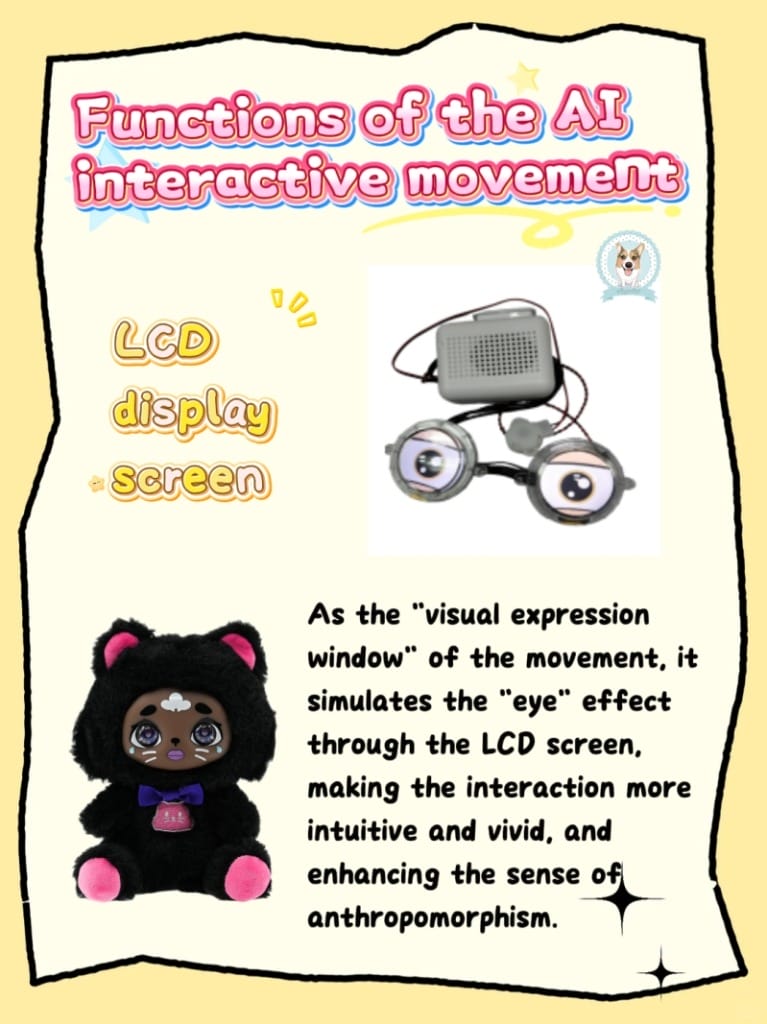
- LCD Display (Smart Eyes, Visual Feedback Function): As the “visual expression window” of the movement, it simulates “eye” effects through the LCD screen, making interactions more intuitive and vivid, and enhancing the anthropomorphic feel.
(1) Dynamic expression display: The screen can display various anthropomorphic expressions such as happiness, surprise, shyness, and sleepiness, which change synchronously with the voice content, giving the device more emotional warmth.
(2) Information visualization presentation: It displays basic information such as time, weather, volume, and power, and can also synchronize text prompts of voice content (such as lyrics, story fragments) or display simple icons (such as playing, charging, network status) to help users understand the device status.
(3) Enhanced interaction feedback: After receiving user instructions, it responds through effects such as screen flickering and eye gaze shifting, allowing users to clearly know that the device has received the instructions and improving the certainty of interaction.
(4) Scene-based visual effects: Some support custom screen content. For example, children’s toys can display cartoon patterns, and learning devices can display knowledge points in graphics and text, adapting to the visual needs of different usage scenarios.
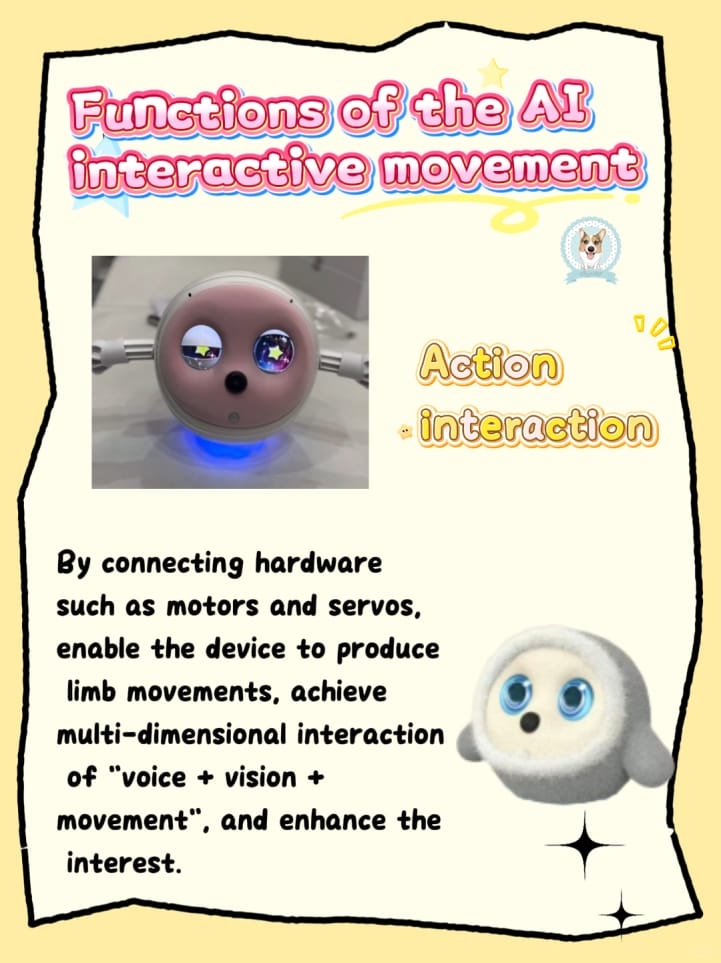
- Motion Interaction (Physical Feedback Function): By connecting hardware such as motors and servos, the device can generate physical movements, achieving multi-dimensional interaction of “voice + vision + motion” and enhancing interest.
(1) Basic motion response: Execute preset actions upon receiving voice commands or triggering specific conditions, such as turning the head, waving the hand, nodding, and shaking the body.
(2) Linkage of motion with voice/expression: The motion is synchronized with voice and screen expressions, making the interaction more coherent and natural.
(3) Tactile-triggered motion: Some are equipped with tactile sensors. When users tap, hug, or press the device, corresponding motion feedback is triggered.
(4) Scene-specific motion design: Customize exclusive motions according to the product form. For example, intelligent plush toys have “waving to greet” and “curling up to sleep”; educational robots have “bending down to greet” and “gesturing to explain knowledge points”, which enhances the interactive experience of the product.
Advantages of AI Intelligent Interactive Movement
- Emotional companionship: From “static decoration” to “dynamic partner”, it remembers user preferences and forms an exclusive interaction style.
- Screen-free enlightenment: A “lightweight solution” that balances learning and health, with scenario-based knowledge infiltration, eye-friendly features and content security.
- Interactive experience: “Immersive interaction” with multi-modal integration. “Voice + movement + touch” collaborative response, which is more interactive and interesting than traditional toys.
- High adaptability and low-threshold experience. The plush shell is soft in texture with no sharp edges, suitable for young children to grasp and hug; it achieves diversified implementation covering all age groups.